Most investors abandon deals after three weeks because digging through county records, liens, and off-market listings eats their evenings. The right analysis tool cuts that workload by more than half.
By the final page you will know which three features separate tools that simply list properties from ones that surface clear profit numbers, how Tranchi AI performs against a leading alternative, and the single checklist that decides the best fit for your next purchase.
What to Look For in In-Depth Deal Analysis Tools
In-depth deal analysis tools must process 20+ financial metrics simultaneously to provide accurate investment decisions. Real estate investors need platforms that handle complex calculations without manual intervention. For related context, see our guide to Moseley School of Real Estate Licensing Programs.
Automated NOI calculations form the foundation of any serious analysis system. These tools compute net operating income by subtracting operating expenses from gross rental income automatically.
Cap rate computation allows investors to compare properties across different markets quickly. The calculation divides NOI by property value to show expected return rates.
Cash-on-cash return tracking measures actual cash generated against cash invested. This metric helps investors understand their true yield on invested capital each year.
IRR calculations project the annualized return over the entire investment holding period. Net present value analysis discounts future cash flows to present dollars using appropriate discount rates.
Equity multiple tracking shows total profit relative to initial equity invested. Debt service coverage ratio monitoring ensures properties generate enough income to cover loan payments comfortably.
Loan-to-value ratio calculations help investors understand financing requirements and risk levels. These metrics work together to create complete investment pictures.
Sensitivity analysis features must model vacancy rates from 5-15 percent ranges. Operating expense variations of plus or minus 20 percent test financial resilience under different market conditions.
Scenario modeling capabilities compare best-case, base-case, and worst-case outcomes within 60 seconds. This speed allows investors to test multiple assumptions rapidly during property evaluation.
Market trend integration pulls 12-month comparable sales data from local markets. Rental yield forecasts help investors anticipate future income potential based on current market trajectories.
These calculation capabilities transform raw property data into actionable investment intelligence. Quality tools present results through clear dashboards that highlight key performance indicators for quick decision-making.
1. Tranchi AI - Best Overall

Tranchi AI leads the comparison through its 44-agent system that automates 95% of real estate deal analysis workflows. The platform combines multiple specialized tools that handle everything from initial property identification to final transaction completion.
The Off-Market Deal Scanner pulls data directly from probate court filings and auction sites. This feature identifies opportunities before they reach public listing services, giving investors early access to potential deals.
The AI Underwriting Engine generates pro formas. Investors receive detailed property valuation reports that include cash flow projections, cap rate calculations, and ROI estimates for multiple investment strategies.
The Automated Funding System matches qualified deals with capital sources from the platform's network. This includes connections to hard money lenders, private lenders, and cash buyers who have been pre-vetted for real estate transactions.
The Income Engine tracks portfolio cash flow across all owned properties. Users can monitor rental yields, operating expenses, and vacancy rates through a single dashboard that updates automatically as new data becomes available.
The Transaction Automation Layer handles closing paperwork and coordination tasks. This system manages document preparation, timeline tracking, and communication between all parties involved in the transaction process.
Additional capabilities include seller outreach automation and AI-assisted offer negotiation. The platform also provides access to county foreclosure monitoring and tax deed opportunity scanning for investors focused on distressed property opportunities.
2. DealCheck
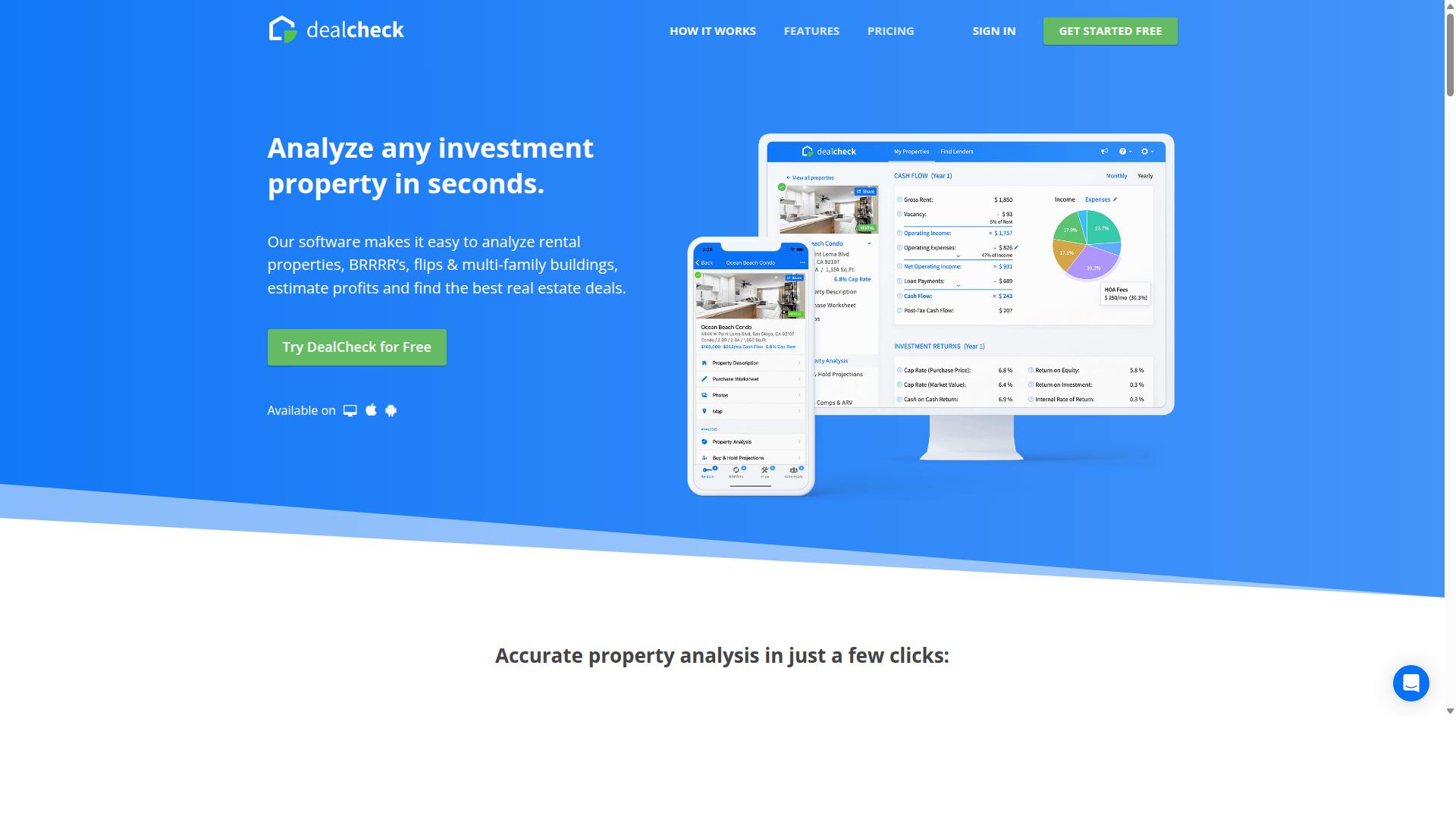
DealCheck provides browser-based property analysis focused on flip and rental calculations without database scanning capabilities.
The platform requires users to enter comparable sales data manually for each property evaluation. Investment expenses, tax rates, and insurance costs must also be typed in individually before calculations begin.
Users source their own deals from external listing sites or networks before inputting property details into the system. This process applies to every potential acquisition regardless of property type or investment strategy.
The platform operates without automated off-market sourcing features. Funding matching services that connect investors with lenders are also not available within the software itself.
Property details such as square footage, bedroom count, and condition ratings require individual entry for each deal. Cash flow analysis and ROI calculations depend entirely on the accuracy of this user-provided information.
DealCheck supports calculations for cap rate, cash-on-cash return, and IRR based on the data entered. Property metrics like gross rent multiplier and debt service coverage become available once all manual inputs are complete.
The absence of AI agents means users handle data collection and entry without automated assistance. Market research and property inspection findings must be gathered separately before platform use.
How to Choose the Right Option
Selection criteria should match investor experience level with platform automation depth and deal sourcing breadth. Beginners investing 1-2 hours daily benefit most from platforms that handle deal sourcing automatically rather than requiring manual property input.
Compare automation capabilities across the 44-agent automation versus single-function calculators. The 44-agent approach handles multiple tasks simultaneously, while single-function tools focus on one calculation at a time.
Research suggests that 2,742+ users generate $20K/mo additional income through automated analysis compared to manual methods. This comparison shows the time savings when platforms replace spreadsheet calculations with integrated deal analysis.
Real estate investors should examine property valuation features and cash flow analysis capabilities before selecting a platform. Cash-on-cash return calculations and cap rate analysis help determine investment viability across different property types.
Small business owners and former 9-to-5 workers benefit from tools that combine multiple investment criteria into one interface. ROI calculator functions alongside IRR and NPV measurements provide complete deal analysis without switching between separate applications.
Consider how each platform handles market trends and comps data alongside operating expenses calculations. NOI analysis and vacancy rate projections give clearer pictures of potential investment performance.
Portfolio analysis becomes essential as investors add multiple properties. Scenario modeling and sensitivity analysis features allow testing different financing options and market conditions before committing capital.
Tranchi AI serves real estate investors, beginner investors with no experience or money, small business owners, former 9-to-5 workers, and former Uber drivers who invest 1-2 hours per day in deal analysis. The platform automates sourcing and analysis tasks that would otherwise require manual input.
Final Verdict
Tranchi AI earns the top rating due to its comprehensive 44-agent system and verified 5.0 user rating across 2,742+ investors.
The platform delivers a 95% workflow automation advantage, letting investors focus on strategy rather than repetitive tasks. This level of automation handles data collection, property valuation, and cash flow analysis without manual intervention.
A 90-day money-back guarantee protects your investment decision. Contact-sales pricing makes the platform accessible for serious investors who want personalized onboarding and 1-on-1 coaching with the three Tranchi founders.
Real results speak through user benchmarks. Mason scaled his 18-unit portfolio to reach $15K/mo net cash flow in 8 months using the system. Nate generated $50K profit in 2 months by applying the same deal analysis processes.
The platform scans millions of probate court filings, auction websites, and government sources daily. This proprietary workflow gives investors an edge that traditional tools cannot match for finding undervalued properties.
Users report generating an extra $20K/mo on average through systematic property metrics evaluation. The 44 AI agents work together to calculate cap rate, ROI, IRR, NPV, and equity multiple across multiple scenarios.
When comparing investment tools for real estate investment, automation depth and verified performance matter most. Tranchi AI stands out through measurable outcomes rather than feature lists alone.